
UK Foodservice Trends 2026: Key Insights for Food and Drink Marketers
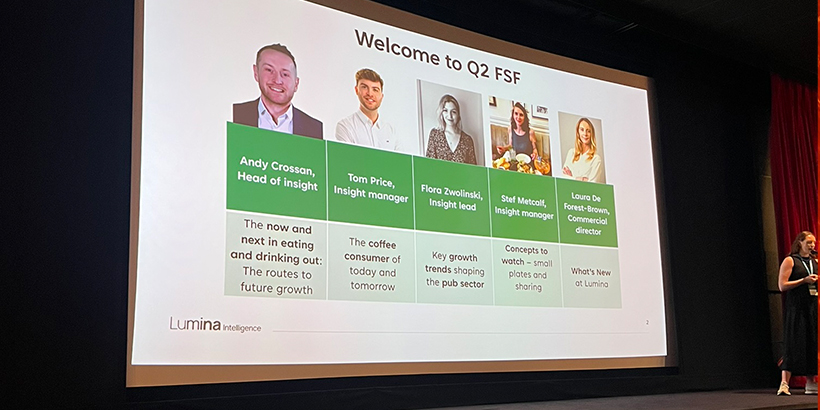
As a leading food and drink marketing agency, we make it our business to keep up with the latest trends and insight. Abi and I were delighted to attend Lumina Intelligence’s Q2 Food Strategy Forum on behalf of Team Bean earlier this month, and we came back with a clear picture of the foodservice trends that 2026 is being shaped by.
Here are our top takeouts and what they mean for brands in foodservice.
Where is the UK out-of-home eating market growing in 2026?
Growth is real but uneven, with food-to-go, travel-led dining and the coffee shop sector leading the way.
The UK eating and drinking out market is forecast to reach £102.8 billion this year, up 1.8% on 2025. That sounds reassuring until you look at what is driving it: inflation, not volume.
The headline number flatters what is actually quite a fragmented picture. Independent operators are forecast to see turnover growth of just 0.7% this year, while ten pub closures per week are expected across 2026, and the broader service-led restaurant estate has been shrinking consistently.
The segments growing with genuine momentum are food-to-go, travel-led dining and the coffee shop sector. Retail, travel and leisure is forecast to outpace the market, driven by formats that flex to capture commuter, airport and high-footfall missions.
For foodservice brands, the message is clear: location and format matter more than they did three years ago. The right proposition in the wrong place is no longer a recoverable mistake.
What are the key coffee shop trends in the UK for 2026?
The UK coffee shop market is polarising, with value players and provenance-led independents growing while mid-market brands lose ground.
Coffee shop penetration has fallen over the past four years, partly the result of price increases across hot drinks. Greggs, averaging £2.90 per coffee, is growing through affordable quality and trend-led innovation including a matcha range. Independents like Monmouth Coffee are winning on provenance and community. Those caught in the middle are losing ground.
Iced drinks are a clear bright spot, with cold coffee growing in share year on year, driven by customisation. Oat milk usage in iced coffee has risen over the last 12 months. And with 56% of coffee shop menu items now customisable, personalisation has become a baseline expectation rather than a point of difference.
What do UK pub market trends tell us about 2026?
The pub sector faces ongoing pressure, but operators focused on proposition clarity, better drinks ranges and community programming are outperforming.
Lumina’s Flora Zwolinski framed the pub session around three imperatives: refine, reimagine and reconnect.
- Refine means tailoring propositions to location: city-centre pubs need fast service and app ordering; village pubs should invest in locally sourced ingredients and quality.
- Reimagine means taking the drinks menu seriously. Only 12% of consumers buying alcohol-free options in pubs never drink at all. These are regular drinkers managing their intake, which makes quality, not availability, the real gap to close. Cocktails are the second most popular drink choice for 18-24 year-olds in pubs, yet most venues still don’t have a credible offer.
- Reconnect is about getting back to what pubs exist for. Solo visits and group friend occasions are both growing. The pubs doing it well are those creating reasons to visit beyond drink: community events, creative programming and social spaces that people genuinely choose over staying home.
How is the UK foodservice consumer behaving in 2026?
Higher-income consumers are driving growth, but quality, health and value are rising selection factors across all income groups.
Growth across every channel is being driven by higher-income consumers. Only households earning £100,000 or above are growing participation in coffee shops. Affluent 25-34 year-olds are the most active and growing segment across foodservice.
But the picture is not simply about who has money. Healthy food options, quality of ingredients and value for money are the three fastest-growing reasons consumers choose where to eat out. Brands that can genuinely deliver on quality and communicate value clearly are winning across both ends of the income spectrum.
Why are small plates and shared eating experiences growing in 2026?
Consumers increasingly see food as a social and cultural act, driving demand for shared formats, hero dishes and experience-led occasions.
Chicken festivals, pickle celebrations, produce parties and viral snack hunts are all expressions of the same shift: people want to be part of something.
Provenance continued to surface as a theme throughout. British provenance and locally sourced ingredients were flagged as a key differentiator for service-led operators. For food and drink brands, the ability to tell a credible origin story is only growing in value.
What do these foodservice trends mean for your brand?
Lumina’s latest insights confirmed what we see in our own client work: the foodservice market is not short of opportunity, but the path to growth requires more precision than it used to. Format, location, occasion, consumer segment and price architecture all need to work together.
If your brand operates in food and drink and you’d like to talk through what these trends mean for you, we’d be glad to help. And if you enjoyed reading this blog, why not sign up to our newsletter to find out all the latest food and drink news, trends and what we’ve bean up to.
Source: Lumina Intelligence Q2 Food Strategy Forum, Everyman Cinema, 18 June 2026.

- UK Foodservice Trends 2026: Key Insights for Food and Drink Marketers - 23rd June 2026
- Feel Good Food: Exploring the Future of Eating Out on Lumina’s Q3 Food Study Tour - 8th October 2025
- Lumina Intelligence Q3 Food Strategy Forum – Key Insights for UK Foodservice - 8th October 2025