
Lumina FSF Q3 Debrief: New beginnings: the effect on hospitality
At Lumina Intelligence’s Q3 Food Strategy Forum this September, Insight Manager Adrian Kowalski opened the morning with a session titled “New beginnings: the effect on hospitality”. His starting point was August’s GfK consumer confidence score of -14, the strongest reading the UK has seen in two years. His question was whether it marks a real shift in the UK hospitality outlook or just a brief lift in mood.
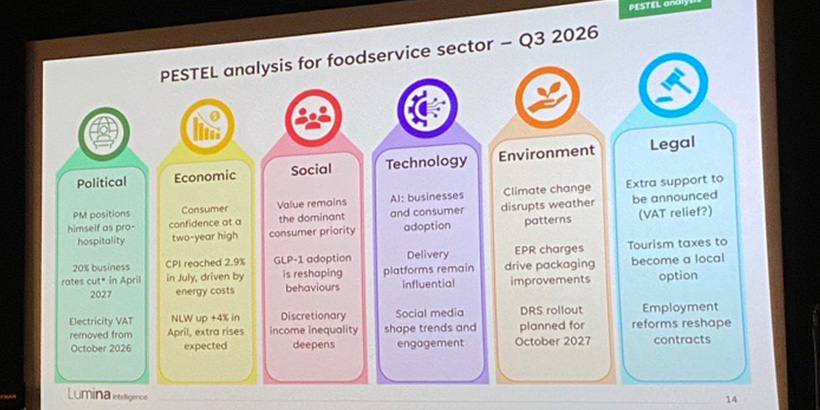
To answer it, Adrian worked through a PESTEL analysis (political, economic, social, technological, environmental and legal factors) of the foodservice sector. The value of the framework, he argued, is that it shows how these forces connect. Policy affects costs, costs shape pricing, pricing drives demand and demand moves through the whole value chain.
Here are our key takeouts from his analysis that we think matter most for foodservice brands planning their next 12 months.
What is the Burnham bounce?
The Burnham bounce is the rise in UK consumer confidence that followed Andy Burnham becoming Prime Minister on 20 July 2026. GfK’s index climbed from -25 in April, its lowest point since November 2023, to -14 by August.
Context matters here. -14 is still a negative score, so this isn’t a return to full optimism. The last time UK consumer confidence that was actually positive was January 2016(!), which means the country has spent more than a decade below zero.
Even so, it’s the direction that counts for hospitality. People who feel better about their own finances and the wider economy tend to go out more and spend more when they do. For a sector that lives on discretionary spend, that’s welcome news.
Hospitality business rates, VAT and the cost question
Political, economic and legal factors decide how much consumers can spend, how much businesses have to absorb and where the pressure lands. On all three, the picture is mixed.
A more hospitality-friendly government
The tone from Westminster has changed. The new Prime Minister has positioned himself as pro-hospitality and his early measures back that up. With pubs, social clubs and live music venues in England will get a 20% cut to their business rates from April 2027.
Not everyone benefits from that 20% cut, though. Restaurants, hotels and cafés aren’t covered. Since the Lumina session we have also had the Budget, which sadly did not deliver the VAT cut the sector was hoping for with the ‘VAT’s the Problem Campaign’. Instead, it offered targeted business rates support: the small business rates relief threshold rises to £18,000 from April, taking around 3,500 pubs, 3,900 restaurants and 2,200 cafés out of rates altogether, pubs’ rates relief increases to 35%, and larger hospitality venues will see their rates bills capped at inflation for two years. Youth minimum wage bands were also retained. On the other side of the ledger, alcohol duty rises by at least 4.5% from February with no change to the draught discount, the National Living Wage goes up 3.9% to £13.21, and regional mayors will be able to introduce a tourist tax on overnight stays from 2028. There was no movement on employer NI and no energy support for the sector, with hiring grants for young people and apprentices offered in place of lower employment taxes. It’s also worth noting that the freeze is a real-terms rather than a cash freeze, with inflation forecast at around 3.5%, and that the rates support applies in England only and runs out in March 2029. The bottom line being that it could have been worse, but it wasn’t what the industry was hoping for.
Feeling better is not the same as being better off
CPI inflation reached 2.9% in July, driven mainly by energy costs. The National Living Wage rose 4% in April, and the Budget has since confirmed a further 3.9% rise from April 2027, taking it to £13.21 an hour. Operators are still absorbing higher costs for labour, energy, ingredients, packaging and transport. Continuing tension between the US and Iran is keeping energy markets uncertain too.
Adrian summed it up neatly. Confidence is improving faster than affordability. The result is a consumer who feels better but still behaves cautiously.
Regulation to watch
At the time of the forum, the biggest unknown was VAT. Adrian described possible VAT relief for hospitality as the single largest swing factor, because it feeds straight into prices, volumes and profitability across the supply chain.
The industry had been campaigning hard for a cut from 20% to 10%, but the Chancellor left hospitality VAT untouched in the Autumn Budget. For now, that relief isn’t coming.
Tourism taxes are another one to track. Edinburgh introduced its visitor levy this year and other areas are discussing similar schemes. If local authorities end up setting their own rates, businesses operating across several regions face a more complicated picture.
Then there’s employment reform. Changes to contracts, scheduling and employment costs land hard in such a labour-intensive sector. Adrian shared a line he’d heard at another conference, that hospitality is “the gap between wage and welfare”.
How are UK consumers changing?
Three social shifts stood out.
Value remains the dominant priority. GLP-1 medications are starting to reshape what and how people eat on a larger scale, and a tablet version became available in the UK shortly before the forum. Lumina’s Morgan Griffiths covered GLP-1 in much more depth later in the day.
The third shift is a widening gap in discretionary income. Some consumers are visiting less often or switching to cheaper channels. Others are still spending, but they’re choosy about where they spend their money.
Fried chicken shows how both can be true at once. Chicken remains one of the more affordable proteins, which suits value-focused diners. Yet premium chains such as Popeyes, Wingstop and Dave’s Hot Chicken keep expanding. Value doesn’t have to mean trading down. Value can absolutely be about quality, as consumers want to feel they have spent their money wisely.
Foodservice trends in technology and the environment
On technology, three themes came through: AI adoption, the ongoing influence of delivery platforms and the growing role of social media.
AI tools like ChatGPT, Microsoft Copilot and Google Gemini are already changing how businesses analyse information, forecast demand and run their operations. Deliveroo and Uber Eats remain important channels. And social media increasingly decides what people discover and what they crave.
The standout example was KFC’s Picklemania, launched in March. The story goes that it started with a video of Dua Lipa adding pickles to a Diet Coke. KFC picked up the idea and built a limited-time menu around pickle flavours, and it became one of the brand’s most successful limited-time offers in the UK.
On the environment, Adrian’s point was simple. Environmental pressures are now commercial pressures. Changing weather patterns affect farming, ingredient availability and logistics, as well as the occasions people eat out for and what they order.
Packaging is the other big one. Extended Producer Responsibility charges are already in place and the Deposit Return Scheme is planned for October 2027. Sustainability used to be mostly about reputation. Now it shows up in costs, operations and everyday business decisions.
Five takeaways for the foodservice sector
Adrian closed with five points for the industry.
- Sentiment is a tailwind, not a fix. Consumers feel better but remain cautious and value-led.
- Cost relief is real but partial. Labour, energy, ingredient and packaging pressures are still active across the value chain.
- With no cut in VAT forthcoming operators continue to face challenging trading and squeezed margins with 82p in every pound of pre-tax profits taken in taxes.
- Technology is moving from experiment to expectation. The clearest short-term gains are in forecasting, productivity and waste reduction.
- Packaging decisions now carry a live cost signal. That affects product design, logistics, channel economics and customer value.
What the UK hospitality outlook means for foodservice brands
His overall verdict was that this is a more encouraging environment, but not necessarily an easier one. We’d agree.
For brands selling into foodservice, a few things follow. Operators are squeezed on cost and labour, so messaging that shows how a product saves time, cuts waste or protects margin will land harder than price alone.
Diners are value-led but still willing to pay for something that feels worth it. That leaves room for premium products, as long as the reason to buy is clear. And Picklemania is a reminder that trends can jump from social feed to menu board fast. Brands that spot them early and move quickly will have the edge.
Adrian ended on collaboration. Success, he said, will depend on organisations sharing insight, planning across the value chain and tackling these challenges together.
If you’re planning your 2027 foodservice activity and want to talk through what these shifts mean for your brand, get in touch with the
jellybean team here. Equally, if you would like to find out what 7 trends are likely to be shaping menus in 2027 click here.
Source: Adrian Kowalski, “New beginnings: the effect on hospitality”, Lumina Intelligence Q3 Food Strategy Forum, 17 September 2026. Data cited in the session from GfK, MCA Insight, BBC, The Grocer, Morning Advertiser and GOV.UK. Autumn Budget updates from the 28 October 2026 Budget.

- Lumina FSF Q3 Debrief: New beginnings: the effect on hospitality - 12th November 2026
- Global Roots, Local Soul: A Food Tour Through Dalston - 21st May 2026
- Arena: The Road to Net Zero - 10th July 2025