
Alsace Food and Wine: Cycling the Route des Vins d’Alsace
Most people plan a holiday around a beach or a city. At jellybean, we plan ours around lunch. So when my friend in Basel suggested cycling the Route des Vins d’Alsace, the only real question was how much Alsace food and wine we could fit into one trip.
The answer turned out to be quite a lot. We flew into Basel (where my friend lives), hired bikes in Lörrach, just over the German border, took the train to Strasbourg and on to Molsheim, then pedalled south through vineyards and half-timbered villages all the way to Colmar. Here’s what we ate, what we drank and what we’re still craving.
Rosheim and Obernai: Alsace food and drink from the first climb
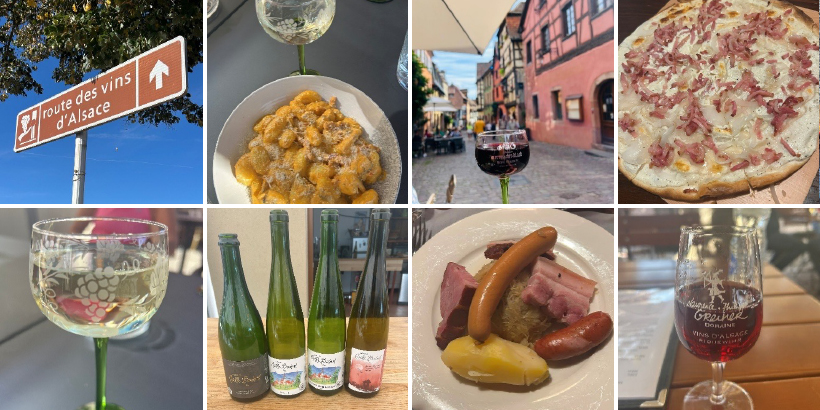
The first lesson of the Route des Vins is that vineyards grow on hills. The second is that the hill is always worth it. After a climb that nearly finished us off, we rolled into Rosheim at lunchtime and ordered the simplest thing on the menu: gnocchi with cream, tomatoes and bacon. Nothing clever. Just exactly right and delicious.
With it came a glass of Muscat, served in the traditional Alsatian wine glass with its tall green stem. Alsace Muscat smells sweet and grapey but drinks dry and fresh, which catches almost everyone out the first time.
A short ride on, Obernai is the kind of town that makes you slow down whether you want to or not. Painted houses, a cobbled square and window boxes everywhere. It’s also where we got properly acquainted with Gewürztraminer, the region’s richer and more perfumed white. Think lychee, rose petals and a gentle sweetness that loves spicy food and strong cheese.
Alsace wine tasting at Domaine Noëlle Bachert in Barr
Barr was the stop we’d been looking forward to most, and our dégustation at Domaine Noëlle Bachert more than lived up to it. What makes this corner of Alsace special is how much variety is squeezed into so little ground. Soils, slopes and sunshine change from one hillside to the next, and the wines change with them. Tasting these wines side by side, in the place where they are made, you start to understand why Alsace winemakers talk about their vineyards the way the rest of us talk about family.
What is Klevener de Heiligenstein?
Klevener de Heiligenstein is one of those rare Alsace white wines made from the Savagnin Rosé grape. It’s grown in only a handful of villages around Heiligenstein, right next door to Barr. Dry, softly aromatic and gently spiced, it sits somewhere between an elegant Pinot and a Gewürztraminer.
It was my absolute favourite of the whole trip. It’s also the bottle I’m now hunting down back home.
Ribeauvillé and Riquewihr: medieval villages and unfinished wine
We stayed over in Ribeauvillé, a village so pretty it feels slightly unreal, with three ruined castles keeping watch from the hills above. Dinner for me was the local dish known as the five meats, a generous plate of choucroute, Alsace’s slow-cooked sauerkraut, piled high with sausages, smoked pork and more besides. Hearty doesn’t quite cover it. And maybe not the most aesthetically pleasing but when in Alsace it’s one you’ve got to at least try!
The next morning we took a hike through the vines to Riquewihr. With its ramparts, crooked lanes and barely a beam out of place, it’s one of the best-kept medieval villages we’ve ever seen.
Here we tried something completely new to me: young wine that was still very much a work in progress. Still cloudy, still lively and nowhere near a bottle, it was sweet, fruity and gone far too quickly. It’s the kind of wine you can really only drink where it’s made, which is exactly why a wine holiday like this one is worth the effort.
What is tarte flambée? The Alsace dish we can’t stop thinking about
Tarte flambée, or Flammekueche in the Alsatian dialect, is a very thin flatbread made from unleavened dough, spread with crème fraîche and topped with sliced onions and bacon lardons. It’s baked quickly in a scorching hot oven until the edges blister and crisp.
The story goes that bakers once used it to test the heat of their wood-fired ovens before the bread went in. Today it’s the dish every table orders, tears apart by hand and orders again before the first one’s gone. The base shatters and the crème fraîche turns rich and slightly tangy, while the bacon and onion bring salt and sweetness. We also tried a sweet version topped with banana, cream and chocolate.
Colmar and Petite Venise: a final Alsace food and wine feast
The last ride took us into Colmar and straight to Petite Venise, where canals wind between flower-covered, half-timbered houses. We celebrated the only way that made sense, with an amazing cheese and meats selection and more wine. More Muscat and more Crémant d’Alsace.
By the end we’d worked our way through Crémant, Riesling, Pinot Gris, Pinot Noir, Sylvaner, Muscat, Gewürztraminer and, of course, Klevener de Heiligenstein. Not bad for a trip powered mostly by pedals.
Why every jellybean holiday starts with the menu
This is how it always goes for us. We’re food and drink obsessives, so every trip comes back with new cravings, new favourites and a list of recommendations. It’s the same curiosity we bring to the food and drink brands we work with every day.
Alsace has given us plenty to talk about. There’s Klevener to track down, tarte flambée to recreate at home and a very strong case for doing the whole route again.
Follow jellybean on instagram @jellybeanagency for more food and wine finds from our travels, our kitchens and the brands we love.

- Alsace Food and Wine: Cycling the Route des Vins d’Alsace - 23rd September 2026
- Why Italian Food Brands Keep Winning in the UK - 18th September 2026
- Great Shopper Marketing Is Integrated by Instinct - 15th September 2026