
Arena Summer Event – Shaping the Future of Foodservice and Hospitality
Arena’s Summer Event took place this year at the Jumeirah Carlton Tower in Knightsbridge, a day dedicated to shaping the future of foodservice and hospitality. Arena gatherings are always a reliable barometer of industry mood, and this one delivered sharp insight, honest conversation and a wonderful lunch.
In a nod to Arena’s recent breakfast events, sponsors Tims Dairy kicked the day off with their delicious strawberry Greek Family Yogurt. Arena Director Lorraine Wood welcomed the room before handing over to Hallam Wood, Head of Out of Home at Tims Dairy, who shared the story of the family-owned British business with true Greek heritage. Derived from the family name of Timotheou, Tims, have been making yoghurt, kefir and cultured cream since 1949, using West Country milk for their signature thick and creamy texture. The room tucked in to their pots and one lucky attendee even won a Tims hamper of goodies!
A Fork in the Road: what the NIQ data tells us
Then to the market, as Reuben Pullan, Senior Insight Consultant at NIQ, opened the formal programme with A Fork in the Road, a clear-eyed look at the challenges facing the industry. Every operator surveyed could name a challenge for the year ahead. Most named four or five. Plenty named eight or more, which gives you a sense of the current state of play.
The context is sobering. Great Britain has lost 15% of its licensed sites since before the pandemic and, while closure rates have stabilised, churn continues: in the year up to June 2026, 3,885 sites closed and 3,703 opened, a challenge in itself for suppliers. Food and drink cost inflation is the most widely anticipated operator challenge, cited by 82% of leaders, with employment costs (75%) and VAT (73%) close behind, though ranked by severity, government taxes and levies come top. Foodservice price inflation has compounded to around 50% above 2020 levels, and the war in the Middle East is already showing in fuel prices, with food inflation to follow as fertiliser costs impact food production.
The consumer picture offers some comfort. Asked how venues should respond to rising costs, 35% would pay more to keep the quality; only 13% would accept lower quality to hold prices. Rather than trading down, they are trading up, eating out less often but spending more when they do. Spend per head has climbed to £24.49 while 42% eat out weekly. Despite the pressure, 82% of leaders disagreed that premiumisation is dead, a belief echoed by the room.
GLP-1s are firmly on operators’ radars, with small plates and sharing dishes tipped as a big trend, a flexible way for those with reduced appetites to enjoy dining out. Tech may be a smart solution for younger demographics, with under 35s in pubs preferring to order via tech rather than a person, trimming high staffing costs.
As for sustainability, cost pressures have seen some operators switch to shorter term priorities, but it remains key for others, generally driven from the top of the brand.
What do suppliers and operators need to do?
Suppliers win in 2026 by proving they understand their customers’ business, not just by delivering a quality product at a fair price. That means help with waste, forecasting, supply chain and staff training, defending value rather than defaulting to discounts and showing up as a genuine partner when procurement reviews come around.
The data backs this up. Operators rate suppliers well on ease of doing business and product quality, but understanding of their business is where satisfaction falls short, with support beyond product scoring lowest of all. With procurement renegotiation the second biggest cost action for the year ahead, plenty of supplier relationships are up for review. The counter is to earn your place: waste reduction, improved forecasting and supply chain optimisation attract more operator focus than renegotiation. Marry this with training support that helps operators upsell and retain staff and you’re on to a winner.
On pricing, 81% of leaders agree discounting is an unsustainable trap, yet the share of sales value discounted crept from 8.0% in 2023 to 9.4% in 2025, so there may be an argument for it as an occasional lever. Best placed to win? Premium casual, experience led, independents, all day dining and focused menus.
A lunch that did its sponsors proud
After the presentation came more networking and bubbles, with delicious canapés featuring products from Délifrance and Clawson Farms, while Nescafé and Clawson Farms hosted branded sampling areas to find out more.
The formal lunch opened with a leek and Clawson Farms Blue Stilton tarte with bitter leaf salad and aubergine caviar, followed by a Ballantine of chicken with confit leg and mushroom tarte, clotted cream mash and jus, finishing with a red berry and pistachio rose with raspberry sorbet from La Compagnie des Desserts. Unity Wines and Spirits kept glasses filled, from a Tosti Florabella sparkling to a lively Godessa Assyrtiko, billed as Greece’s answer to Chablis, plus a Spanish rosé from Cariñena. Nescafé coffee rounded things off nicely.
Before the afternoon’s panel session, Karis Thomas highlighted Arena Futures and the Networking Navigator programme, which upskills foodservice professionals’ networking abilities and encouraged attendees to put forward any colleagues who would benefit as part of their professional development.
The panel: AI, data, innovation, culture and careers
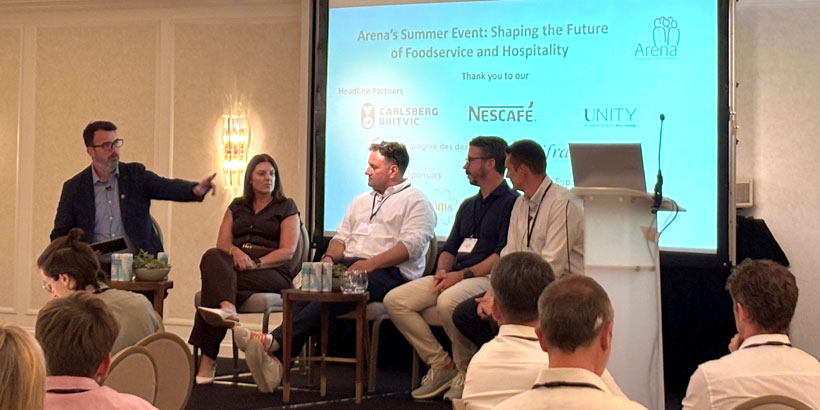
The afternoon panel, hosted by Mark Stretton, CEO of Fleet Street, brought together Samantha Davis, Chief Commercial Officer at Foodbuy; Tom James, Managing Director of Bill’s; Robbie Laidlaw, Managing Director of Thomas Franks and Joe Cripps, Technology Strategy at German Doner Kebab, to examine what is shaping their organisations and strategies.
On AI, the message was clear. The theatre is over and the practice has begun. After two years of conference talk, accessible AI tools and properly organised data mean insight is no longer locked away with the finance team. Tom James shared a Bill’s trial giving general managers live data and AI powered team leaderboards, which saw guests spend an extra 20p a head across ten restaurants, which delivered thousands in extra revenue for minimal investment. The discipline, the panel agreed, is choosing the three to five things that matter and always asking ‘why are we doing this?’ and ‘what do we want to achieve?’.
Joe Cripps framed it as effectiveness rather than automation, meeting teams where they already are with nudges through WhatsApp and kitchen screens rather than another app to learn. Whilst in workplace catering, kiosks are easing peak queues while keeping the barista connection, and automated invoicing is freeing teams to look after guests.
On culture, teams and careers, Samantha Davis called for more women on boards, with structured development, mentoring and an understanding of work life balance. Robbie Laidlaw brought personal experience to bear on inclusivity, making the case for an industry more welcoming to neurodivergent and disabled individuals. Hospitality remains the biggest employer of unqualified people in the UK, and the panel made a passionate case for the sector as a force for social mobility.
The day closed in style with the charity raffle raising £900 for Springboard. Strong insight, top leaders and a lot of food for thought. Watch out for more on the September event, tantalisingly trailed by Lorraine as a behind the scenes leisure venue tour! As well as the next Arena Futures event which is on the 10th of September with the next Navigator cohort kicking off on the 20th of August.

- How to Choose a Foodservice Marketing Agency for 2027 - 24th August 2026
- Canadian Cuisine: The Next UK Foodservice Trend? - 17th August 2026
- New school food standards: what school suppliers must know - 24th July 2026